
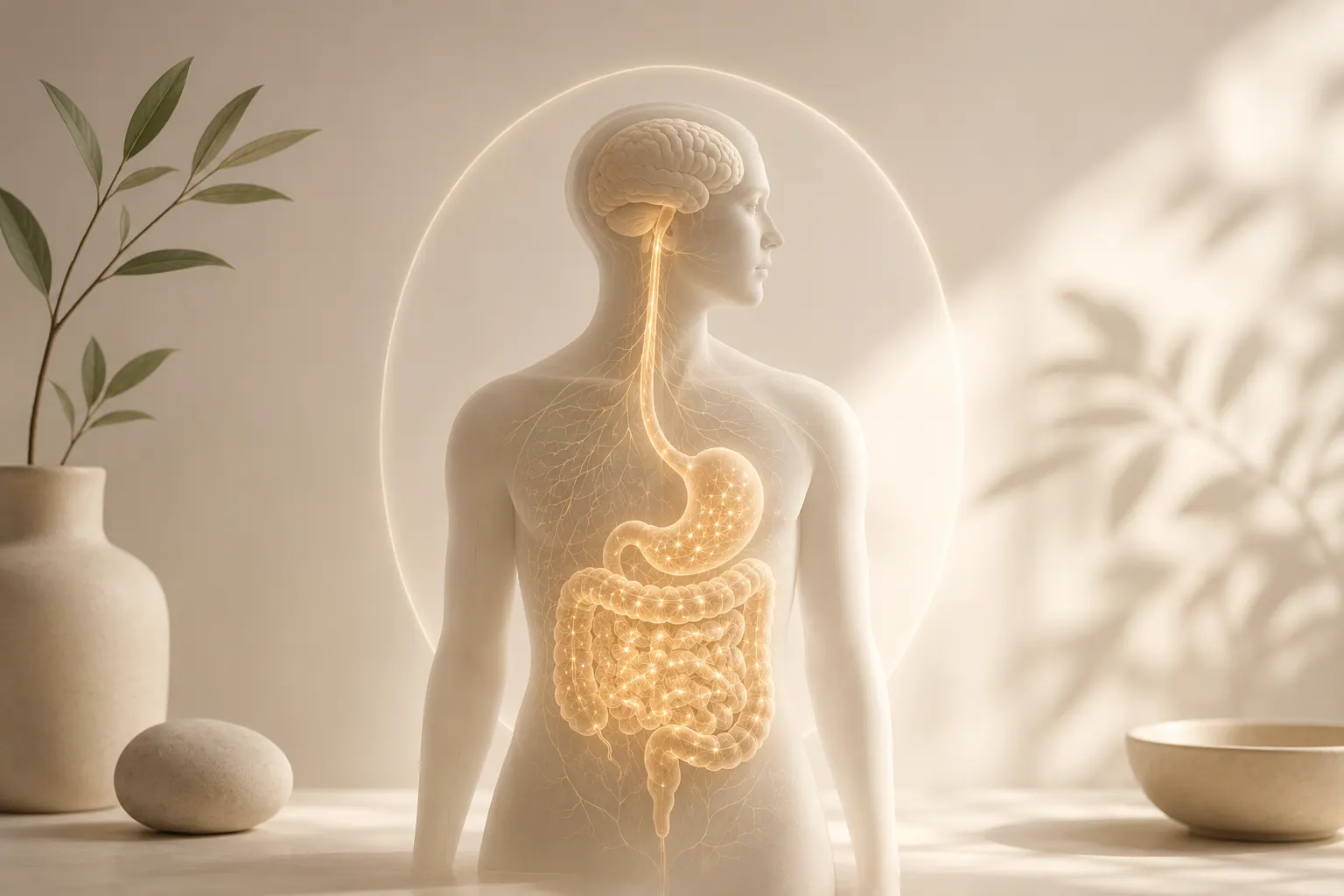
500 million neurons you never think about
The enteric nervous system — a mesh of roughly 500 million neurons lining the gastrointestinal tract — is the only organ system capable of operating entirely independently of the brain. It manages digestion, secretion, and blood flow through the gut wall without a single instruction from the central nervous system. Neuroscientist Michael Gershon, who coined the term "second brain" in his landmark 1998 book, argued that this neural network is not merely a relay station: it makes decisions, learns from experience, and communicates bidirectionally with the brain via the vagus nerve. What we now know, three decades into microbiome research, is that the gut's influence on cognition, mood, and immune function is not metaphorical. It is biochemical, measurable, and profoundly affected by what we eat — and what we fail to eat — every single day.
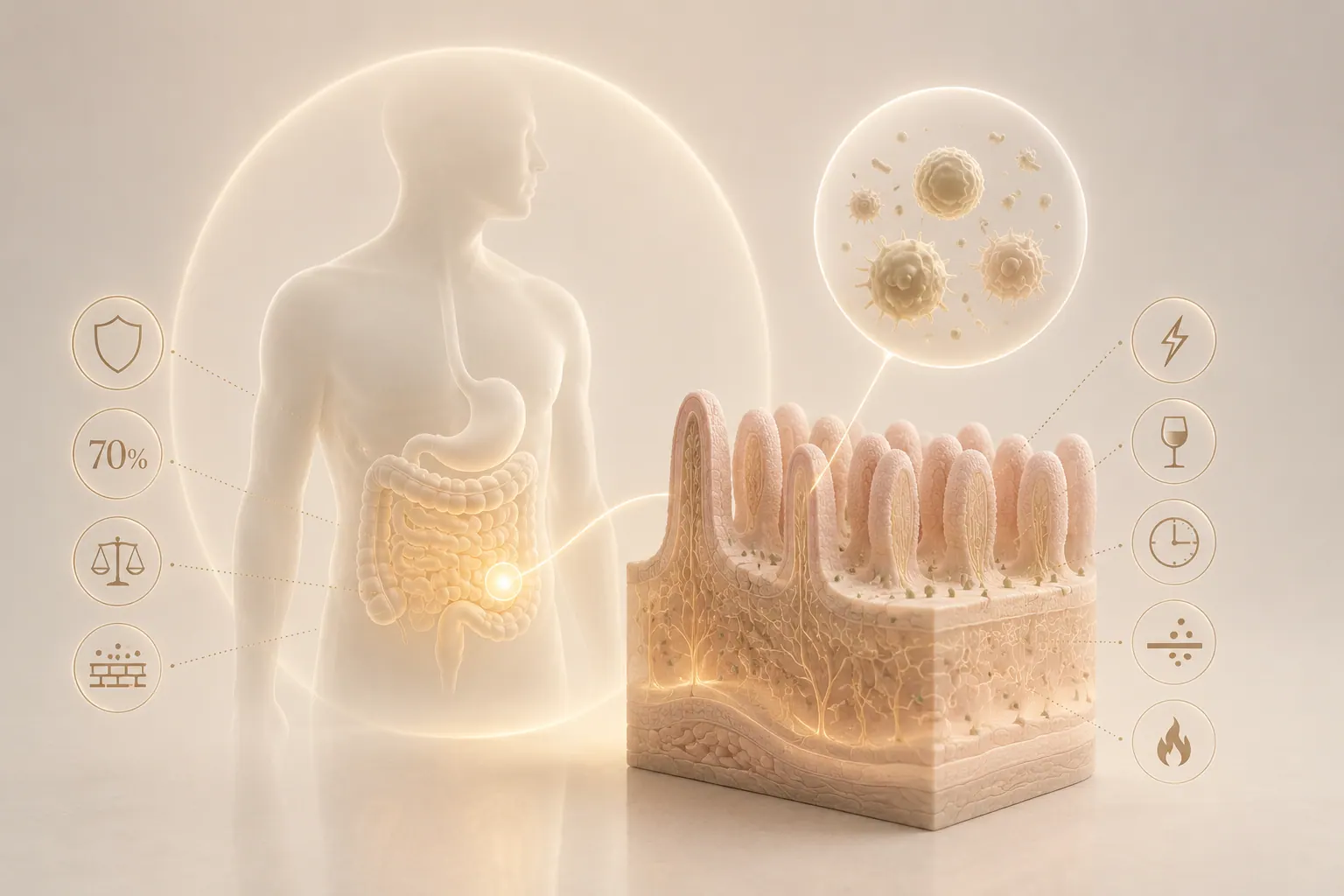
70% of your immune system lives in your gut
The gut-associated lymphoid tissue (GALT) constitutes the largest mass of immune tissue in the human body. Approximately 70% of all immunoglobulin-producing cells reside in the intestinal mucosa, where they monitor the boundary between self and environment — a surface area roughly the size of a tennis court when the villi and microvilli are unfolded. This is where immune tolerance is calibrated: the ability to distinguish between a harmless food protein and a dangerous pathogen. When the intestinal barrier is compromised — through stress, poor diet, alcohol, or the circadian disruption of long-haul travel — partially digested proteins and bacterial endotoxins (lipopolysaccharides) leak into the bloodstream, triggering a low-grade inflammatory response that immunologists call "metabolic endotoxaemia." The symptoms are subtle but cumulative: brain fog, joint stiffness, skin reactivity, and a vague sense of fatigue that no amount of coffee resolves.
"All disease begins in the gut." — Hippocrates, circa 400 BCE. Twenty-four centuries later, molecular biology is proving him right.
The vagus nerve: a two-lane highway
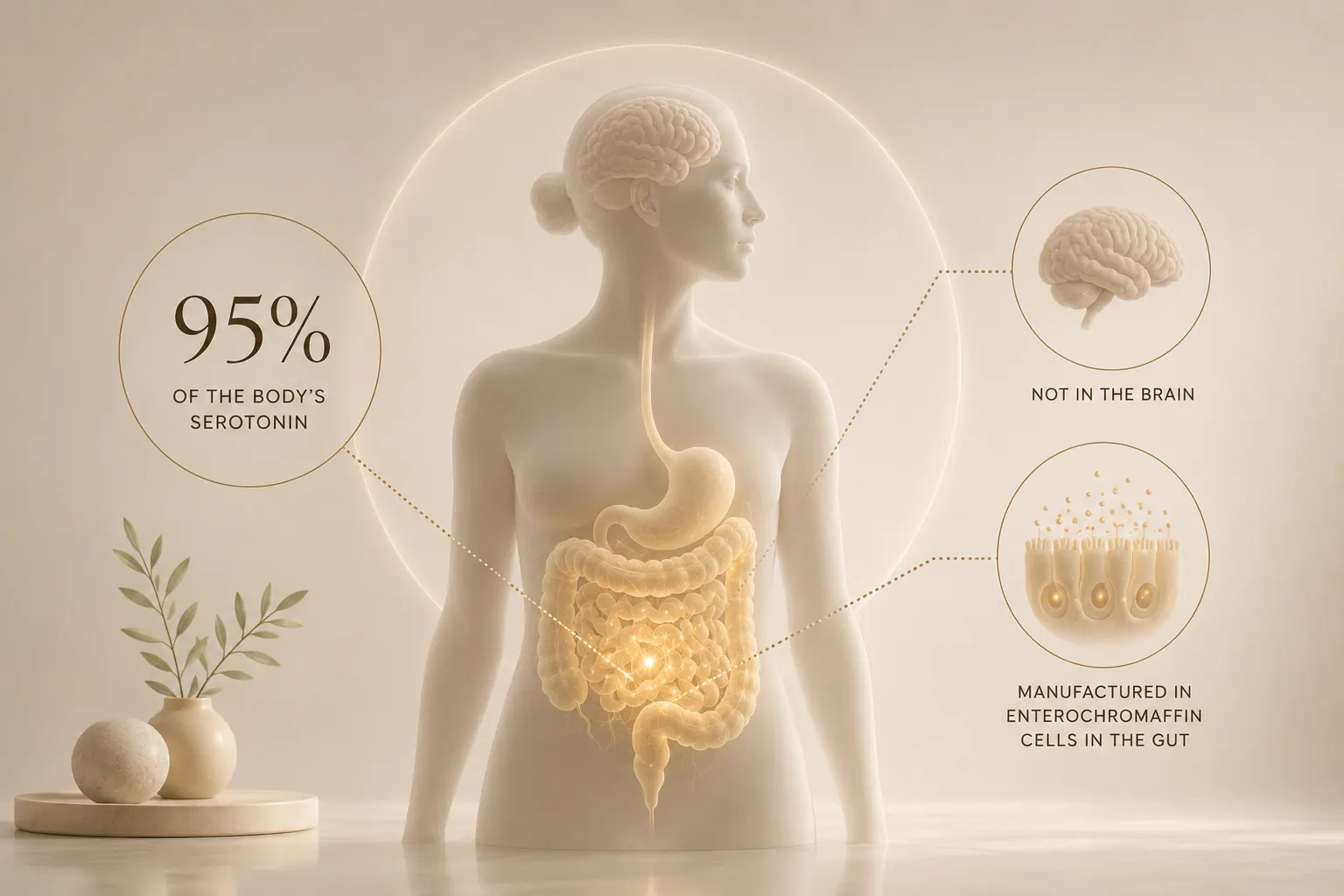
The vagus nerve is the longest cranial nerve in the body, running from the brainstem to the colon, and it carries information in both directions. Critically, roughly 80% of its fibres are afferent — meaning they transmit signals from the gut to the brain, not the other way around. This asymmetry has radical implications. When gut bacteria ferment dietary fibre into short-chain fatty acids like butyrate, those molecules stimulate vagal afferents that signal the brain to produce serotonin and gamma-aminobutyric acid (GABA), the neurotransmitters most associated with calm, focus, and emotional regulation. In fact, approximately 95% of the body's serotonin is manufactured in enterochromaffin cells in the gut, not in the brain. A 2019 study in Nature Microbiology analysing over 1,000 subjects in the Flemish Gut Flora Project found that two bacterial genera — Coprococcus and Dialister — were consistently depleted in individuals diagnosed with depression, even after controlling for antidepressant use. Your mood, in a very real sense, is being co-authored by your microbiome.
Travel and the microbiome crisis
Frequent travel is one of the most potent disruptors of microbial diversity. Circadian misalignment from crossing time zones alters the cyclical fluctuations of gut bacteria (yes, your microbiome has its own circadian rhythm). Cabin pressure at cruising altitude reduces intestinal motility and increases gas expansion in the bowel, contributing to bloating and constipation. Hotel meals — often rich in refined carbohydrates, seed oils, and low in fibre — starve the beneficial bacteria that depend on complex plant polysaccharides for fuel. A study published in Cell in 2014 by researchers at the Weizmann Institute demonstrated that jet lag alone was sufficient to shift the gut microbiome toward an obesogenic profile within 48 hours, and that this shift was transmissible: when the altered microbiota was transplanted into germ-free mice, those mice gained weight. The business traveller who flies weekly is not just tired. They are hosting a microbial community under chronic siege.
Prebiotics, probiotics, and the foundation of clean nutrition
Probiotics — live bacterial strains delivered through supplements or fermented foods — receive the most attention, but they are only half the equation. Without prebiotics — the non-digestible fibres that feed beneficial bacteria — probiotic strains cannot colonise effectively. Think of probiotics as seeds and prebiotics as soil. The most well-studied prebiotic fibres include inulin (from chicory root), fructo-oligosaccharides (FOS), and galacto-oligosaccharides (GOS), all of which selectively promote the growth of Bifidobacterium and Lactobacillus species. However, the single most impactful intervention for microbiome diversity is not a supplement — it is the elimination of ultra-processed food. A 2024 meta-analysis in The Lancet Gastroenterology & Hepatology concluded that each 10% increase in ultra-processed food as a proportion of total caloric intake was associated with a 14% reduction in microbial species richness. Clean nutrition — whole, minimally processed, fibre-rich foods — is not a luxury. It is the baseline requirement for a functioning gut-brain axis.
Building the foundation, one morning at a time
At OTHERROOM, we approach gut health not as a separate pillar but as the substrate upon which every other pillar rests. Our Fuel products are formulated without artificial sweeteners (which studies have shown to disrupt Bacteroides populations), without emulsifiers like carboxymethylcellulose (linked to mucosal thinning in animal models), and without the seed oils that promote endotoxin translocation across the gut lining. The Morning Fuel blend includes prebiotic acacia fibre to nourish resident bacteria, while the Longevity Shot's reishi beta-glucans act as immunomodulators in the GALT itself. Every ingredient is chosen not only for what it delivers but for what it does not disrupt. Because in the ecology of the gut, what you leave out matters as much as what you put in. Your second brain is listening. Feed it accordingly.