
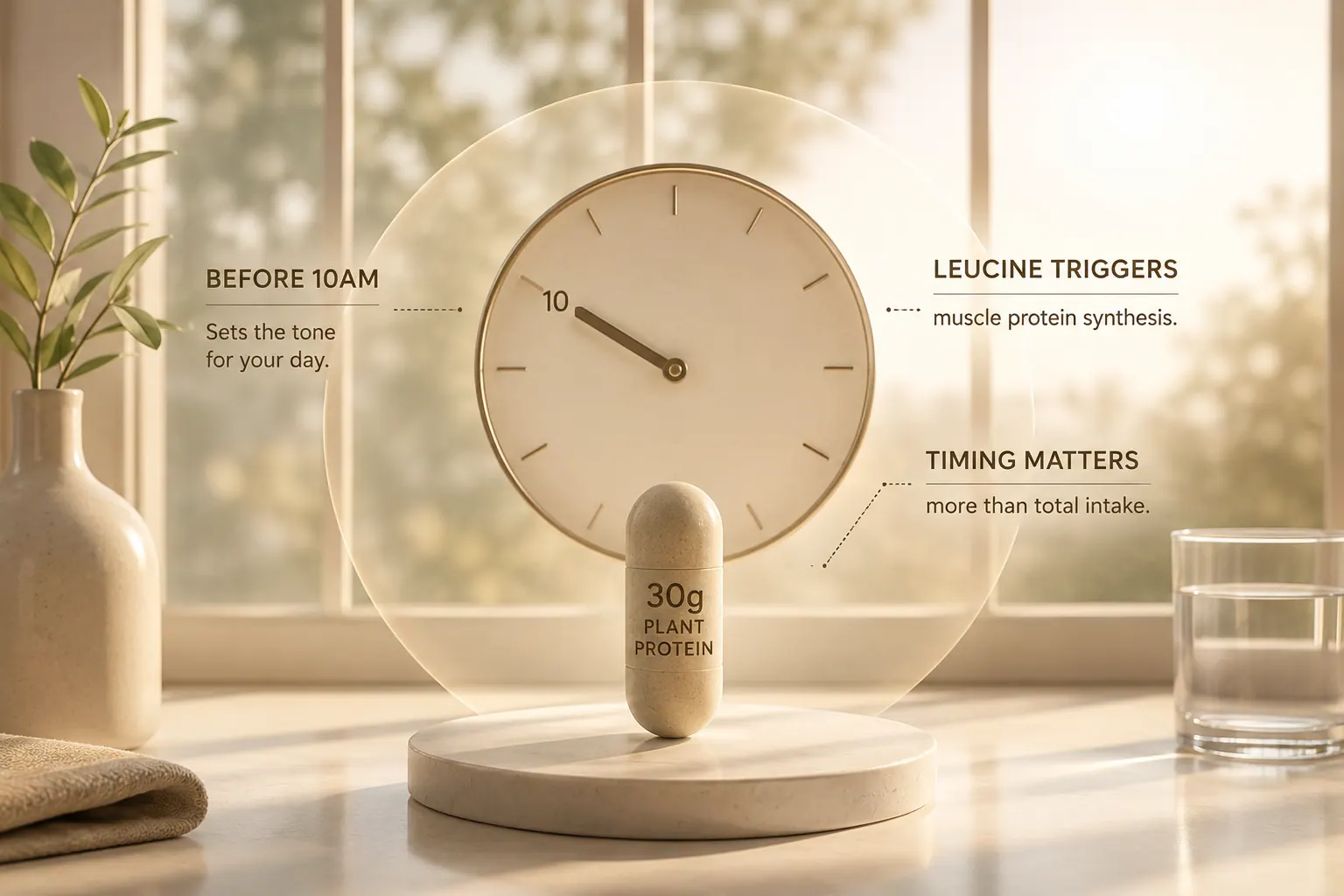
The leucine threshold: 2.5 grams to flip the switch
Muscle protein synthesis — the process by which your body repairs and builds lean tissue — is not a continuous drip. It operates more like a switch, and that switch has a name: the leucine threshold. Research from the University of Texas Medical Branch has established that approximately 2.5 grams of the branched-chain amino acid leucine is required to maximally activate the mTOR signalling pathway, the master regulator of MPS. Below that threshold, you may be eating protein, but your muscles are barely listening. A croissant and coffee delivers roughly 0.3 grams of leucine. A typical hotel buffet yoghurt with granola reaches about 1.2 grams. Neither comes close. This is the fundamental problem with how most people start their day: they eat, but they don't trigger the one anabolic signal that matters most in the first hours of waking.

Why 30 grams before 10 AM matters
After seven to eight hours of sleep, your body has been in a catabolic state — breaking down tissue for energy and repair without any incoming amino acids. Cortisol peaks within 30 to 45 minutes of waking (the cortisol awakening response), and while this hormone is essential for alertness, it is also proteolytic: it accelerates muscle breakdown. Consuming 30 grams of high-quality protein before 10 AM provides roughly 2.7 to 3.0 grams of leucine — enough to cross the threshold — and shifts the body from catabolism to anabolism. A landmark 2018 study in Cell Reports by researchers at the Waseda University in Tokyo found that protein intake skewed toward the morning produced significantly greater muscle hypertrophy than the same total daily protein consumed primarily at dinner. The total amount was identical; only the timing differed. The morning group gained measurably more lean mass over twelve weeks.
"It's not just how much protein you eat — it's when you cross the leucine threshold that determines whether your muscles grow or erode." — Dr. Layne Norton, nutritional scientist
Plant versus whey: the bioavailability question
Whey protein isolate has long been the gold standard for MPS because of its rapid absorption kinetics and naturally high leucine content (approximately 11% by weight). Plant proteins — pea, rice, hemp — typically contain less leucine (7–8%) and are absorbed more slowly due to their fibre matrix and anti-nutritional factors like phytates. However, blending plant sources strategically changes the equation. A pea-rice blend achieves a complete amino acid profile that rivals whey, and fortifying it with free-form leucine can match or exceed the mTOR activation of dairy-based protein. The OTHERROOM Morning Fuel uses exactly this approach: a precision-blended plant protein matrix with added leucine, delivering 30 grams of protein and 3.0 grams of leucine per serve — without dairy, without bloating, without the inflammatory cascade that many people experience from concentrated whey, particularly when travelling and gut integrity is already compromised.

The hotel breakfast problem
Walk into almost any five-star hotel breakfast and you will encounter an abundance of refined carbohydrates: pastries, white toast, pancakes, fruit juices with more sugar per glass than a soft drink. The protein options — eggs, smoked salmon, yoghurt — are present but rarely consumed in sufficient quantity to hit the leucine threshold, especially by guests in a hurry. A two-egg omelette delivers roughly 12 grams of protein and 1.0 gram of leucine. You would need to eat five eggs to reach 30 grams of protein at breakfast, a volume few people manage alongside the cognitive load of a business trip, jet lag, and a 9 AM meeting. The result is a population of high-performing travellers who are systematically under-fuelling their most anabolically sensitive window of the day, every single day they are on the road.
Muscle protein synthesis and ageing
The urgency of morning protein increases with age. After 40, a phenomenon called anabolic resistance sets in: muscles become progressively less responsive to the leucine signal, requiring higher doses to achieve the same MPS response. Research published in The American Journal of Clinical Nutrition suggests that older adults may need 40 grams of protein per meal — with at least 3.5 grams of leucine — to match the anabolic response that a 25-year-old achieves with 20 grams. This is not about bodybuilding; it is about sarcopenia prevention, metabolic health, and maintaining the functional independence that underpins quality of life in later decades. Every morning you skip the protein window, you leave muscle on the table — literally.
Morning Fuel as the solution
The OTHERROOM Morning Fuel was designed around a single clinical insight: make the leucine threshold effortless to cross. One scoop, mixed with water or plant milk in a hotel room, delivers 30 grams of complete protein, 3.0 grams of leucine, and a matrix of digestive enzymes that ensure rapid absorption even in a travel-stressed gut. No buffet queue. No guesswork. No dairy-induced inflammation. It takes 90 seconds to prepare and fits into any carry-on. For hotels that partner with OTHERROOM, it means their guests start every morning in an anabolic state — sharper, more resilient, and better fuelled than the pastry basket could ever achieve.